

Before you sell anything, it helps to understand gold karats: what 24k, 22k, 18k and 14k mean, how purity is stamped and tested, and how a buyer turns weight and purity into an offer. This guide walks through each step, with tables you can use when you look at your own rings, chains and coins at home in Kigali.
What a karat is
Karat (k or kt, spelled carat in British English) measures how much of an item is pure gold, out of 24 parts. 24k is pure gold. 18k is 18 parts gold and 6 parts other metals, so 75 percent gold.
Pure gold is soft. Jewellers mix it with silver, copper, zinc or other metals to make it harder and to change its colour. The more other metal, the lower the karat and the lower the value per gram.
| Karat | Fineness stamp | Gold content | Typical items |
|---|---|---|---|
| 24k | 999 or 9999 | 99.9% to 99.99% | Bars, Maple Leaf and similar coins |
| 22k | 916 | 91.67% | Indian and Gulf style jewellery, sovereigns, Krugerrands |
| 21k | 875 | 87.5% | Arab style jewellery |
| 18k | 750 | 75% | Fine jewellery, diamond rings |
| 14k | 585 | 58.5% | Everyday jewellery, many US pieces |
| 10k | 417 | 41.7% | Budget jewellery |
| 9k | 375 | 37.5% | Common in the UK |
Why karat preferences differ
Where a piece was made often tells you its likely karat. In the UAE, more than half of the gold jewellery sold is 22 karat and about a fifth is 21 karat. Customers from the Arab world tend to prefer 21k, while customers from South and Southeast Asia lean toward 22k. Many families in East Africa own pieces bought in Dubai or made in Indian style, so 21k and 22k are common in Kigali jewellery boxes. Pieces from Europe or the US are more often 18k, 14k or 9k.
A little history
Gold jewellery has a long history in the region. Along the Swahili coast of Kenya and Tanzania, in places such as Lamu, Pate and Zanzibar, smiths made silver jewellery set with embossed gold plaques, shaped by centuries of trade with Oman, the Middle East and India. In Rwanda, adornment traditionally centred more on beadwork and metal bracelets than on gold: the ubutega leg bracelets were a sign of wealth, and archers' arm bracelets marked rank.
How to read hallmarks and stamps
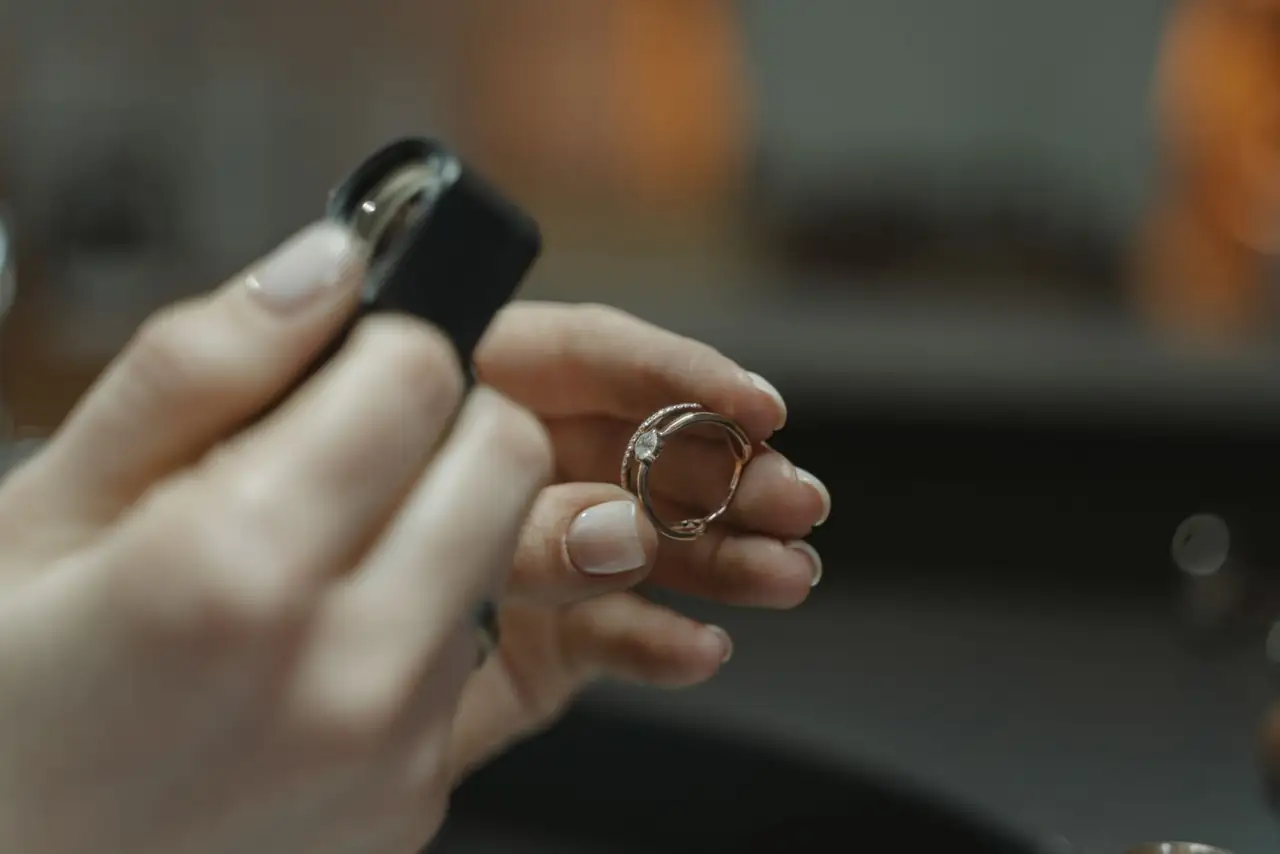
Look inside rings, on chain clasps and on the back of pendants. A magnifying glass or your phone camera on zoom helps.
Fineness numbers and karat marks
The most useful mark is the fineness: a number such as 750, or a karat mark such as 18k. Both tell you the claimed gold content. Some pieces use both, for example "18K750".
Full hallmarks
In countries with official hallmarking, a full hallmark has several parts. The UK system uses three compulsory marks:
- Sponsor's or maker's mark: at least two letters in a shield, identifying who submitted the piece.
- Fineness mark: for example 375, 585, 750 or 916.
- Assay office mark: the office that tested it, such as the leopard's head for London or the anchor for Birmingham.
In India, hallmarked gold jewellery carries the BIS logo, a purity mark such as 22K916, and since July 2021 a six character alphanumeric code called the HUID, which is unique to each piece and can be checked in the BIS Care app.
Many pieces sold in Rwanda, especially older or locally made ones, carry only a karat stamp or no mark at all, so testing matters.
Marks that mean "not solid gold"
| Mark | Meaning | Gold value |
|---|---|---|
| GP or 18KGP | Gold plated: a thin coat of gold over base metal. US rules require at least 0.5 microns. | Very low |
| HGE or HGP | Heavy gold electroplate: a thicker plate, not a legal standard in most markets. | Very low |
| GF or 14K GF | Gold filled: a bonded layer of at least one twentieth of the total weight under US rules. | Low |
| 925 with a gold colour | Vermeil: gold plating over sterling silver. | Silver value plus a little gold |
A piece stamped "18KGP" is plated with 18k gold. The "18K" describes the coating, not the item. This catches many sellers out.
Gold-plated or solid: how to tell
Signs that a piece may be plated or filled:
- A plating mark (GP, HGE, GF) or a silver mark (925) on a gold coloured item.
- Wear on edges and high points that shows a different coloured metal underneath.
- A green or black mark on your skin.
- A very light feel for its size. Gold is dense, about 19.3 grams per cubic centimetre when pure.
- A price at purchase far below the gold value of its weight.
Home checks can raise doubts but cannot prove a piece is solid. A professional test is needed for that.
How purity is tested
| Method | How it works | Pros | Cons |
|---|---|---|---|
| XRF (X-ray fluorescence) | X-rays make the metal give off a signal that shows its composition | Fast, accurate, no damage | Reads only the surface, so thick plating can mislead it |
| Acid test | Item is rubbed on a touchstone and the streak is treated with acids of known strength | Cheap and widely used | Leaves a small mark, less precise, depends on skill |
| Electronic tester | Measures electrical conductivity | Quick, cheap | Less reliable on plated items and some alloys |
| Density test | Weighs the item in air and in water | No damage, catches some fakes | Hard with stones or hollow pieces |
| Magnet test | A strong magnet should not attract gold | Free, instant | Many fakes are non-magnetic, so passing proves little |
XRF is the best option for valuable pieces because it does not damage them. Its weakness is that it analyses only a thin surface layer, about 10 microns deep. A heavily plated fake can read as gold, so careful testers take readings in more than one place, check clasps and cut ends, and combine methods when something looks wrong.
Always ask which method will be used before testing starts. If someone tells you the only way to confirm your gold is to cut or melt it on the spot, be cautious.
Gemstones, diamonds and other parts
Stones are not gold, and their weight should not be paid for as gold. Buyers handle them in different ways:
- Remove the stones and weigh the metal alone.
- Deduct an estimated weight for the stones, which can cost you money if the estimate is generous.
- Value good stones separately: larger diamonds, roughly a quarter carat and up, and quality gemstones may have resale value.
- Pay nothing for small chips: tiny diamonds and low quality stones that are hard to remove usually add no value to a scrap offer.
If a piece has a stone you care about, ask a jeweller to remove it before you sell the metal. Also watch for steel springs inside clasps, solder, and pearls or enamel, which add weight but no gold.
How a buyer values your gold
Buyers start from the melt value:
Melt value = weight (g) x purity x price of pure gold per gram
Then they deduct for testing, refining losses and costs, the risk that the price falls before they sell the gold on, and their margin. The offer you receive is a percentage of melt value.
Example: a mixed jewellery box
Using an indicative 24k price of RWF 196,600 per gram (our live feed on 5 October 2026):
| Item | Weight | Karat | Pure gold | Melt value (approx.) |
|---|---|---|---|---|
| Wedding band | 4 g | 18k | 3.0 g | RWF 589,800 |
| Chain | 12 g | 21k | 10.5 g | RWF 2,064,300 |
| Earrings | 3 g | 14k | 1.76 g | RWF 345,000 |
| Total | 19 g | 15.26 g | about RWF 2,999,000 |
Ask each buyer which weight, karat and price per gram they used. Then divide their offer by your melt value to see the real percentage. Comparing that percentage is the fairest way to compare buyers. For today's figures, use the calculator on our gold price in Rwanda page.
Coins and bars
Well known bullion coins have fixed gold content, which makes them easy to value:
- Krugerrand: 22k, 33.93 g total, containing one troy ounce (31.1 g) of pure gold.
- British sovereign: 22k, containing 7.32 g of pure gold.
- Maple Leaf: 99.99% pure, one troy ounce.
Bars from recognised refiners usually show weight, fineness, refiner and a serial number. Keep any certificate or packaging, as it helps buyers verify quickly.
Ready to sell?
Now that you know your karats, stamps and melt value, you are in a strong position. Read how the process works on sell gold in Kigali, check the home page for the live price, or, if you prefer Kinyarwanda, see igiciro cya zahabu. Then fill in the form below with what you have, and we will help you get fair, transparent offers from licensed buyers and jewellers in Kigali.
Frequently asked questions
What does 750 stamped on jewellery mean?
It means the metal is 750 parts gold per 1,000, so 75 percent gold, which is 18 karat. In the same system 916 means 22 karat, 875 means 21 karat, 585 means 14 karat and 375 means 9 karat. The rest of the alloy is usually silver, copper or other metals.
Is 24k gold better than 18k?
24k is purer and worth more per gram, but it is soft and scratches or bends easily. 22k, 21k and 18k contain other metals that make them harder, which suits rings and chains. For selling, what matters is the pure gold content, so a heavy 18k piece can be worth more than a light 24k one.
How do I calculate the value of my gold?
Multiply the weight in grams by the purity and by today's price of pure gold per gram. For example, 10 g of 18k contains 7.5 g of pure gold. Our gold price in Rwanda page has a calculator that does this with the live price, and a buyer's offer will be a percentage of that figure.
What does GP, GF or HGE mean on jewellery?
These marks mean the item is not solid gold. GP is gold plated, a thin coat of gold over a cheaper metal. HGE is heavy gold electroplate, a thicker coat. GF is gold filled, a bonded layer that must be at least one twentieth of the weight under US rules. Their scrap value is low.
Can a stamp on gold be fake?
Yes. Stamps can be wrong, worn away or deliberately false, and plated items are sometimes stamped 18k on the surface. A stamp tells you what the maker claims. Only testing, ideally with an XRF machine, confirms what the metal actually is.
Does the magnet test prove gold is real?
No. Gold is not magnetic, so if a strong magnet grabs your item, it is not solid gold. But many fakes use non-magnetic metals, so passing the magnet test proves very little. Treat it as a quick first check only.
Are gemstones in my jewellery included in the gold price?
No. The gold price applies to the metal only. Stones should be removed or their weight deducted before the gold is valued. Larger diamonds and good gemstones may be valued separately, while small chips usually add nothing to a scrap offer.